Table of Contents
For law firms, trust is everything, and your website is often where it begins. In an industry where clients are seeking guidance during some of the most important and stressful moments of their lives, your firm’s credibility and professionalism must be evident from the very first impression. Increasingly, that first impression happens online.
Before a prospective client ever picks up the phone or walks into your office, they are likely to visit your website to evaluate whether your firm is the right fit for their needs. Studies show that over 75% of users judge a business’s credibility based on its website design alone¹.
If your site feels outdated, cluttered, or difficult to navigate, potential clients may question whether you bring the same level of attention to detail and excellence to your legal work. On the other hand, a clean, modern, and thoughtfully designed website can inspire confidence and make visitors feel reassured that they are in capable hands.
This article explores how a modern, professional website can position your law firm as a trusted authority in a competitive digital landscape. We’ll break down the essential design elements that create a strong first impression, from mobile-friendly layouts to authentic branding. You’ll also discover strategies for showcasing your firm’s expertise and credibility, ensuring that visitors are not only impressed but also motivated to take the next step and reach out.
By the end, you’ll understand how investing in the right web design services can do more than create an attractive digital presence; it can build trust, strengthen your reputation, and help convert visitors into long-term clients.
Why trust is the cornerstone of law firm websites
In the legal profession, trust is not a mere advantage; it is the very foundation upon which all relationships are built. Clients often seek legal counsel during moments of uncertainty, stress, or vulnerability.
Whether it involves safeguarding a business, resolving a dispute, or protecting a family’s future, they are placing their confidence, and often their livelihoods, into the hands of their chosen attorney. This means that a law firm’s ability to inspire trust from the outset is essential, and in today’s digital age, that initial impression happens online.
Your website is no longer just a digital brochure; it is your firm’s front door. For many potential clients, it will be the first, and sometimes only, encounter they have with your brand before deciding whether to pick up the phone or continue their search elsewhere.
Research indicates that 75% of users admit to judging a company’s credibility based on its website design alone. This statistic underscores the importance of web design and the reality that a poorly designed or outdated website does more than look unappealing; it can actively drive business away.
A law firm’s website must communicate professionalism, competence, and care within seconds of loading. Visitors need to feel reassured that your firm understands their needs and can deliver the level of expertise they require. Clean and user-centric design, intuitive navigation, and a modern aesthetic convey that your firm pays attention to detail and keeps pace with the times.
Conversely, cluttered layouts, slow load times, or broken links raise red flags about a firm’s attentiveness, not only to its digital presence but potentially to its clients’ cases as well.
In a profession where reputation is everything, your website should act as a silent ambassador, reflecting the integrity and excellence of your practice. Building trust online is no longer optional; it is a strategic imperative for firms that want to thrive in a competitive legal landscape.
Take Action
Learn more about our web design service and options available to you, or contact our specialists to discuss how we can realize your vision.
Key elements of law firm website design that build client trust
A law firm’s website is more than a collection of pages; it is a reflection of your firm’s values, professionalism, and ability to handle complex matters with care. Every design choice, from color schemes to typography, contributes to the perception visitors form about your practice.
To build trust and encourage potential clients to take the next step, your website must combine aesthetics with functionality in a way that feels both modern and authentic. In the sections below, we explore what makes a good law firm website design.
Professional aesthetics:
Clean, modern, and intentional
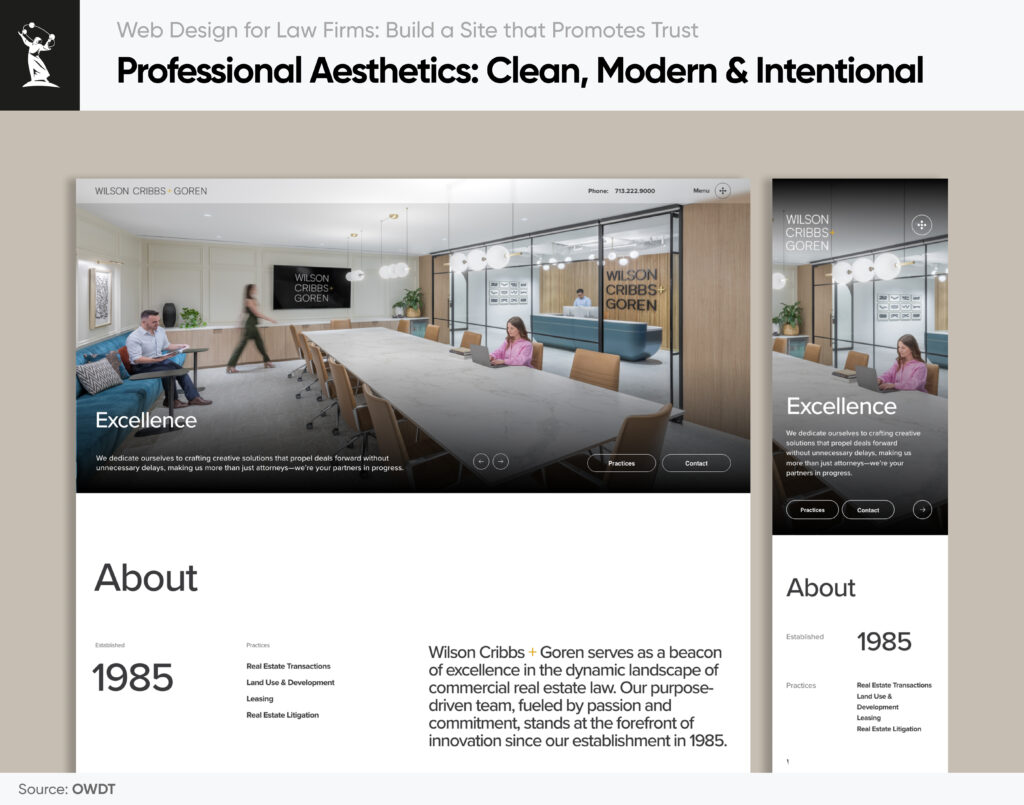
First impressions are formed in seconds, and a cluttered, outdated design can quickly erode confidence. A clean, modern layout communicates sophistication and competence, signaling to visitors that your firm approaches its work with clarity and precision.
The use of a thoughtful color palette, often incorporating deep blues, greys, or muted earth tones, can project authority and calm. Likewise, typography plays a subtle yet powerful role. Serif fonts often convey tradition and reliability, while modern sans-serif fonts suggest innovation and accessibility. Selecting the right combination sets the tone for how your firm is perceived.
Mobile optimization:
Meeting clients where they are
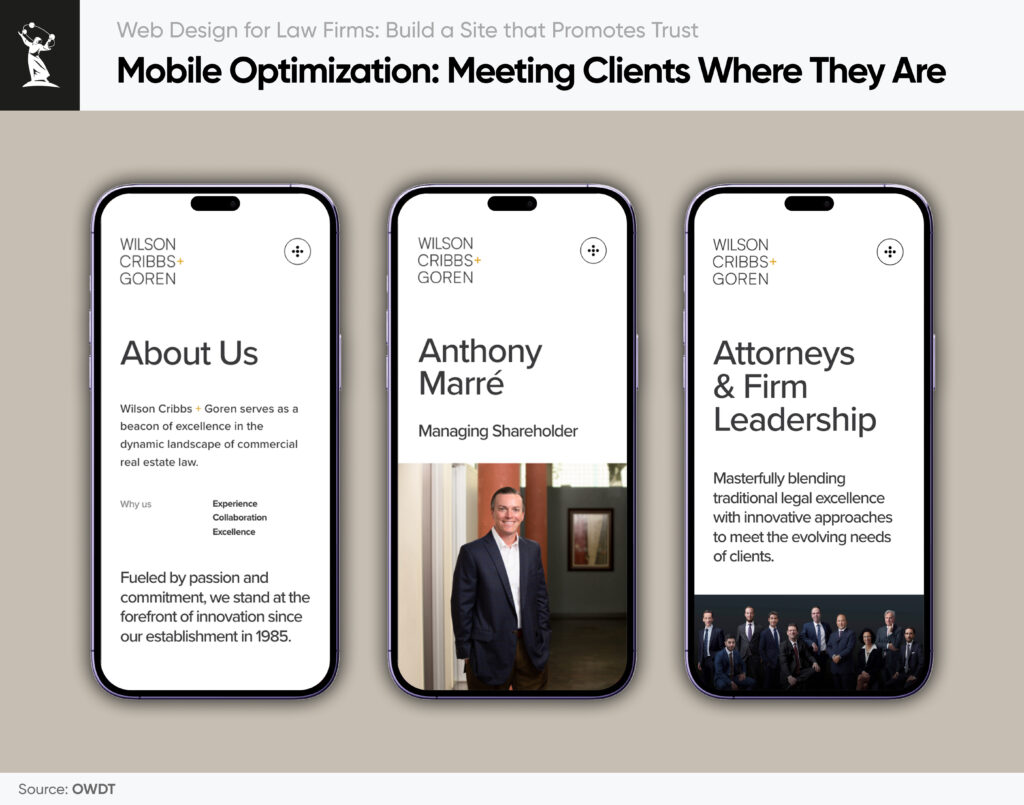
With the majority of web traffic now coming from mobile devices², a responsive design is no longer optional. Clients searching for legal assistance on their phones expect a seamless experience, pages that load quickly, menus that are easy to navigate, and contact buttons that work flawlessly on smaller screens.
A site that fails to perform on mobile devices risks losing prospects before they ever engage with your team. Responsive design, supported by professional technical SEO services, gives potential clients confidence that your firm is modern, accessible, and easy to work with.
Showcasing credibility:
Testimonials, awards, and badges
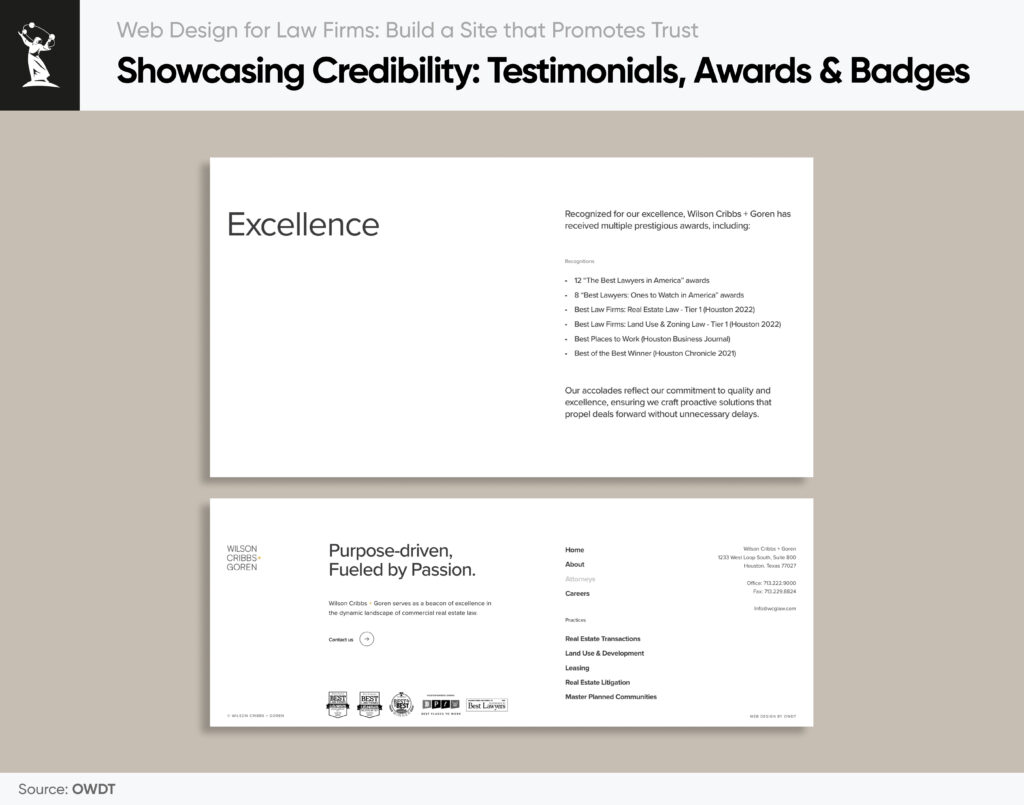
Trust is reinforced when potential clients see evidence of your success. Prominently display client testimonials, case studies, and success stories to give visitors insight into the outcomes you have achieved for others.
Professional affiliations and awards, such as bar association memberships or industry recognitions, also serve as credibility markers, reassuring clients that they are dealing with a reputable, highly regarded firm.
Clear contact information:
Ease of connection

If visitors struggle to find your contact information, they may assume accessibility isn’t a priority for your firm. Ensure that phone numbers, email addresses, office locations, and interactive maps are visible throughout the site, particularly in the header and footer. Including quick “Call Now” or “Request a Consultation” buttons simplifies the process and encourages immediate engagement.
Authentic photography
and branding
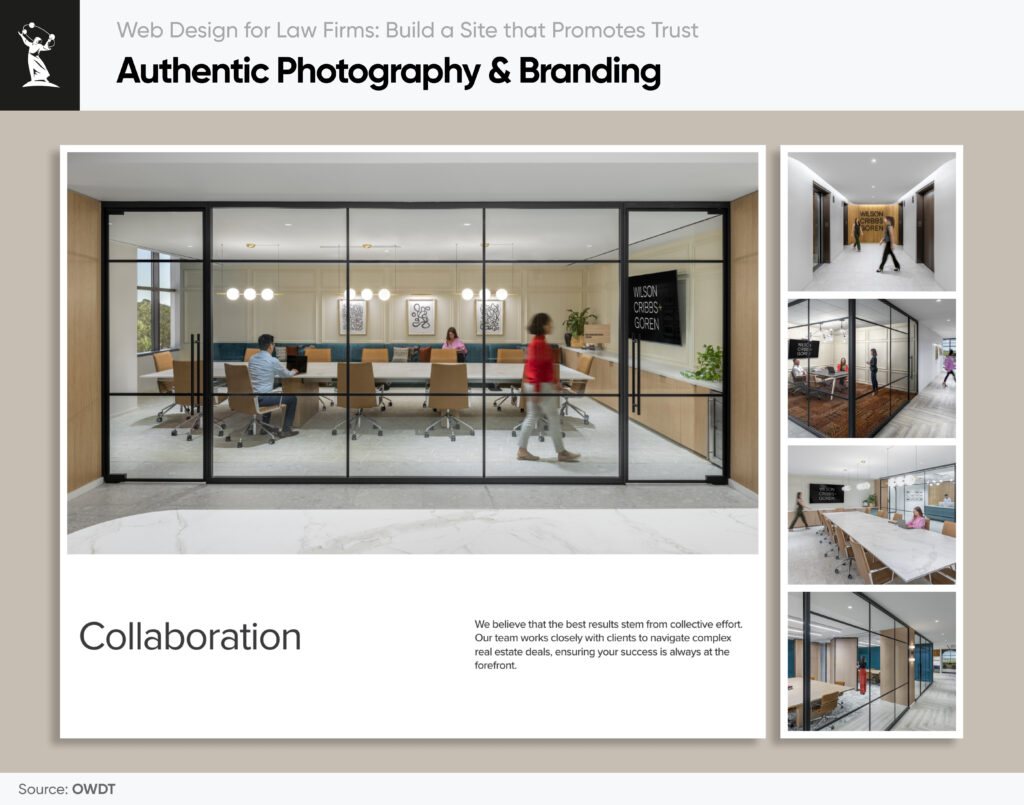
Stock images often feel generic and impersonal, undermining efforts to build trust. Instead, invest in professional photography that showcases your team and workspace. Real photos humanize your firm, allowing potential clients to see the people behind the practice. Consistent branding across visuals and messaging further reinforces a sense of stability and attention to detail.
When these elements work in harmony, your website becomes more than an online presence; it becomes a powerful tool for trust-building, client acquisition, and long-term growth.
Take Action
Learn more about our web design service and options available to you, or contact our specialists to discuss how we can realize your vision.
Turning visitors
into clients:
The power of modern web design
Attracting visitors to your law firm’s website is only the first step; converting those visitors into paying clients is where true value lies. A modern website does more than showcase your services; it creates a seamless user experience that builds trust and encourages prospective clients to take action.
User experience:
Simplicity and speed as silent advocates
User experience (UX) is at the heart of conversion-focused design. Fast load times are essential, as research shows that even a one-second delay in page speed can result in a significant drop in engagement.
Potential clients, particularly those in urgent need of legal assistance, are unlikely to wait for sluggish websites to load. A site that responds quickly sends a subtle but powerful message: this firm is efficient, professional, and attentive to detail.
Equally important is intuitive navigation. Visitors should be able to find information about practice areas, attorney profiles, and contact options without having to search extensively. Clear menus, thoughtful website structure, and strategically placed calls-to-action (CTAs) create a sense of ease and competence, encouraging users to move naturally toward scheduling a consultation.
Building confidence through security and professional tools
In an age where cybersecurity concerns are at the forefront of minds, the presence of HTTPS encryption is no longer optional. A secure site not only protects sensitive client information but also signals that your firm values privacy and takes professionalism seriously. Seeing the familiar padlock icon in their browser can make visitors feel more comfortable sharing personal details or submitting an inquiry form.
Modern features such as live chat or online scheduling tools further enhance client engagement. A live chat option allows visitors to ask quick questions and receive immediate answers, creating an impression of responsiveness and approachability. Similarly, allowing clients to book consultations online, without needing to pick up the phone, caters to the preferences of today’s busy, digitally savvy users.
When these elements come together, they transform your website into more than an online presence. It becomes an active participant in your firm’s client acquisition strategy, converting casual browsers into confident clients ready to entrust you with their legal matters.
Mistakes law firms should avoid in website design
While a well-designed website can be a powerful tool for establishing credibility and attracting clients, even small missteps in design or functionality can undermine your firm’s efforts. That’s why law firms must prioritize functional web design to create an online presence that inspires confidence and drives results.
Neglecting mobile optimization
In today’s mobile-first world, failing to prioritize mobile responsiveness is a critical error. Prospective clients increasingly use smartphones to search for legal services, and a website that doesn’t adapt seamlessly to smaller screens risks alienating them before they’ve read a single word about your firm.
Buttons that are too small to tap, text that requires pinching to zoom, and layouts that break on mobile devices suggest a lack of attention to detail, an impression no law firm can afford to give.
Using outdated or inconsistent design
An outdated website design can inadvertently signal that a firm is out of step with modern practices. Mismatched colors, inconsistent branding, and cluttered pages distract visitors and erode the professional image a law firm needs to convey. Instead, a cohesive, modern aesthetic aligned with your firm’s identity reassures clients that they are dealing with a competent and detail-oriented team.
Overloading the site with legal jargon
While expertise is critical, overwhelming visitors with dense legal language can backfire. Most clients are seeking clear, understandable guidance, not a crash course in legal terminology. Content should be written in a way that balances professionalism with website accessibility, showing that your firm is not only knowledgeable but also approachable and client-focused.
Hiding contact information
If potential clients cannot easily find a way to contact your firm, they are likely to leave and continue their search elsewhere. Burying phone numbers, addresses, or consultation forms deep within the site is a common mistake. Instead, contact information should be prominently displayed on every page, ideally with calls-to-action encouraging visitors to take the next step.
Over-reliance on stock photography
Images play a crucial role in humanizing your firm, but stock photos of handshakes or generic office scenes often feel inauthentic. Prospective clients want to see the people behind the practice. Investing in high-quality, professional photography of your team and office can create a far stronger connection and instill a sense of trust.
By steering clear of these mistakes, law firms can ensure their websites reflect the same level of care, professionalism, and expertise they bring to their clients’ cases. Avoiding these missteps doesn’t just improve aesthetics; it can directly influence whether visitors choose to engage your firm or move on to a competitor.
Take Action
Learn more about our digital agency and options available to you, or contact our specialists to discuss how we can realize your vision.
Law firm website design as a long-term growth strategy
In the legal profession, success depends not only on expertise but also on the ability to cultivate trust. Clients entrust law firms with some of the most significant and sensitive matters in their lives. They need assurance that the firm they choose embodies professionalism, competence, and integrity, qualities that must be communicated before a single consultation ever takes place. This is where the power of modern website design becomes undeniable.
A law firm’s website is no longer a static brochure tucked away in the digital landscape; it is an active participant in shaping perceptions and driving business growth. Every design decision, whether it’s a clean layout, mobile responsiveness, or secure HTTPS encryption, signals how seriously your firm approaches its work.
A sleek, intuitive, and modern website design conveys to visitors that your firm is not only keeping pace with technological advancements but is also attentive to the needs of today’s discerning clients.
Consider the journey of a potential client searching online for legal assistance. Within seconds of landing on your homepage, they form judgments about your firm’s credibility, values, and capability. A site that loads quickly, guides them effortlessly to the information they seek, and showcases authentic imagery and testimonials creates a sense of ease and confidence. By contrast, outdated designs, confusing navigation, or missing contact details can raise doubts and send them looking elsewhere.
Modern website design also plays a crucial role in conversion. Features such as live chat and online scheduling demonstrate your firm’s responsiveness and client-centric approach, while secure forms and clear calls-to-action encourage visitors to take the next step. These elements do more than enhance user experience; they nurture relationships and foster trust even before the first meeting.
Investing in a trusted, professional website is not a mere expense; it is a strategic decision that supports your firm’s long-term reputation and client acquisition efforts. It ensures that your digital presence works for you around the clock, projecting confidence and attracting the kinds of clients who value your services.
In a competitive legal landscape, where first impressions are often formed online, modern website design is not optional; it is essential. Working with the right web design company, supported by ongoing SEO services, ensures that your digital presence continues to connect your firm’s expertise with the clients who need it most. By prioritizing a thoughtful, well-executed strategy, you position your firm not only to succeed today but to inspire trust for years to come.
Sources
[1] Wix. (2024). Web Design Statistics: Facts & Data You Need to Know.
[2] Exploding Topics. (2025). Mobile Internet Traffic: How Much Web Traffic Is Mobile (Stats & Trends).