
Context
Why Websites Underperform
Most digital platforms fail not because of effort, but because of structural misalignment.
Without a clear understanding of how systems interact, organizations invest in improvements that address symptoms rather than root causes.

The Reality
Performance Is a
System Problem.
Improving isolated elements does not fix systemic problems.
Websites do not underperform because of a single issue. Performance is the result of how multiple systems—design, content, data, and structure—work together. When these systems are misaligned, even well-executed initiatives fail to produce meaningful results.
Where Misalignment Happens
Performance issues emerge when key systems operate
without alignment.
To improve performance, digital systems must be evaluated holistically considering how design, content, analytics, and structure interact. This requires a framework that identifies root causes, not just visible issues.
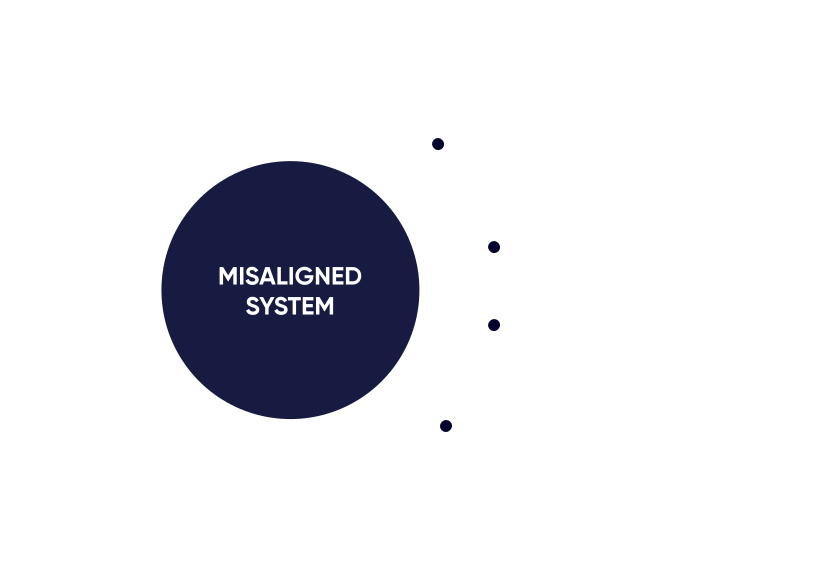

Experience
Structure of user journeys, pathways, and decision flows.
Content
Messaging and structure guiding user decisions
Analytics
Measurement of behavior and performance
Structure
How systems are organized and connected

Framework
From Symptoms to
Structure.
This structured approach provides clarity on how systems function—and where improvement is required.
01
Analytics Integrity
Accuracy of tracking, data collection, and reporting clarity.
02
Conversion Map
Structure of user journeys, pathways, and decision flows.
03
UX Psychology
How design, usability, and cognitive load influence behavior.
04
Intent Alignment
Relevance of content and structure to user expectations and search intent.
05
Benchmarking
Performance comparison against industry standards & competitors.
Where Most Websites Break Down.
Without structured evaluation, improvements are often based on assumption rather than evidence.
Incomplete Analytics
Key actions and conversions are not fully tracked, limiting visibility into performance and decision-making.
Content–Intent Misalignment
Content does not align with user expectations, reducing relevance and conversion potential.
Unclear Conversion Pathways
User journeys lack clear progression, making it difficult for visitors to complete desired actions.
Friction in User Journeys
Design or usability barriers increase effort, leading to drop-offs and reduced engagement.
Weak Navigation Structure
Poor hierarchy makes it difficult for users to find important content and navigate effectively.
Content Architecture Limitations
Weak structure and linking reduce discoverability and limit both user access and search visibility.
Insight
What web design can learn from music
The most effective websites are not just functional. They are composed. With rhythm, harmony, melody, and dynamics, web design becomes more intuitive, cohesive, and memorable.
ContinueInsight
How to build a complete marketing 360 strategy
A 360 marketing strategy unifies every customer touchpoint into one data-driven system. Discover how AI personalization and cross-channel integration help brands turn attention into lasting loyalty.
ContinueInsight
The future of B2B web design: UX, SEO, and personalization combined
Next-gen B2B web design combines UX, SEO, and personalization to turn websites into engines of trust and conversion, using strategic design and data-driven storytelling to fuel growth.
ContinueInsight
Web design and marketing synergy: Secrets to higher traffic and sales
In today’s digital economy, design and marketing must work together. This article demonstrates how their synergy fosters trust, enhances brand strength, and drives sales.
ContinueNews
OWDT Redesigns The Museum of Fine Arts, Houston Digital Experience
The new MFAH.org is built on a design system that mirrors the museum’s architectural calm and visual clarity.
ContinueInsight
Luxury color palette for web design: Boost visual appeal and UX
Learn the principles of high-end color palettes that boost trust, engagement, and brand sophistication.
ContinueNews
OWDT wins prestigious 2025 W3 Award for NRG Park website
OWDT has won a prestigious 2025 W3 Award for its work on the NRG Park website, honored at the 20th Annual W3 Awards celebrating digital creativity and innovation.
ContinueArticle
Web design for law firms: Build a website that promotes trust
First impressions build credibility. Why strategic web design is critical for law firms in today’s digital-first world.
ContinueInsight
User-centered design principles in action: A case study from OWDT
User-centered design (UCD) is a strategic approach that prioritizes user needs, behaviors, and feedback in the design process.
ContinueEntry Point
Where Diagnosis
Begins.
Understand what limits performance, before investing further.
The Digital Performance Audit provides a clear view of how your digital systems actually function;
revealing structural inefficiencies, behavioral friction, and missed opportunities that impact growth.
What Underperformance Actually Costs.
Many organizations attempt to improve performance through isolated actions—redesigning pages, launching campaigns, or adjusting individual elements. Without addressing the underlying structure, these efforts provide short-term gains but fail to create sustainable improvement.
Real performance improvement requires system-level change.
Low-Converting Traffic
Visitors arrive, but few take action. Conversion paths lack clarity, intent alignment, or persuasive structure.
Limited-Return Spend
Marketing investment generates inconsistent or declining returns. Channels operate without clear attribution or optimization feedback loops.
Missed Funnel Opportunities
Key user actions are not tracked or optimized. High-intent users drop off without visibility into why or where.
Unpredictable Results
Results fluctuate across campaigns and channels. Lack of structure makes performance difficult to stabilize or scale.
Decisions Without Data
Strategic and design decisions rely on assumptions rather than evidence. Limited tracking and poor data quality reduce confidence in outcomes.

Next Step
Understand What
Limits Performance.
Identify the structural issues affecting your digital platform before investing in further improvements.
Without a clear understanding of how your systems function, improvements remain fragmented and ineffective. A structured evaluation provides the clarity needed to make informed decisions and drive measurable performance.
Low-Converting Traffic
Attracting visitors is only the first step. conversion depends on alignment between user intent, messaging, and experience.
In many cases, traffic is driven to pages that are not designed to meet user expectations. Messaging may be too generic, calls-to-action unclear, or the journey lacks logical progression. As a result, visitors leave without taking meaningful action.
Conversion issues are rarely about volume, they are about structure. Without aligning content, UX, and intent, even high-quality traffic fails to produce results.
The result is a document that not only explains what is happening, but why — providing a foundation for informed decision-making.

CLOSE PANEL
Limited-Return Spend
Marketing channels often operate without a clear understanding of performance drivers. Campaigns may generate traffic or leads, but without proper attribution and feedback loops, it becomes difficult to identify what is actually working.
Budget is then allocated based on assumptions rather than evidence, leading to inefficiencies and diminishing returns over time.
Sustainable growth requires not just investment, but visibility into how each channel contributes to outcomes.
CLOSE PANEL
Missed Funnel Opportunities
Many organizations lack visibility into how users move through their funnel. Key actions, such as form interactions, drop-off points, or engagement signals, are either not tracked or not analyzed.
This creates blind spots where high-intent users disengage without explanation. Opportunities for improvement remain hidden, and optimization efforts become guesswork.
A clear understanding of the funnel is essential to identify where performance breaks, and how to fix it.
CLOSE PANEL
Unpredictable Results
Inconsistent results across campaigns and channels are often a symptom of deeper structural issues. Without standardized systems for tracking, measurement, and optimization, performance becomes difficult to stabilize.
Changes in traffic sources, messaging, or user behavior can
create significant variation in outcomes; making it difficult to scale
with confidence.
Predictable growth requires a structured system where performance can be measured, tested, and improved consistently.
CLOSE PANEL
Decisions Without Data
Without reliable data, decisions are often based on intuition or incomplete information. This leads to misaligned priorities, ineffective strategies, and missed opportunities.
Even when data exists, poor tracking implementation or
fragmented systems can reduce its reliability; limiting its usefulness
in guiding decisions.
Effective decision-making depends on accurate, accessible, and actionable insights, not just data collection.
CLOSE PANEL
Have a Specialist Contact You
CLOSE PANEL
Tell Us About The Recipient
CLOSE PANEL
We’re collecting this information solely to email you the download link; we won’t use it for mass emails or share it with anyone else. By submitting this information, you’re not entering into any legal agreement, and your data will be securely stored.
Thank You.
Your information has been transmitted successfully and securely.
CLOSE PANEL
Thank You.
Your information has been transmitted successfully and securely.
Please check your email for the download link.
CLOSE PANEL